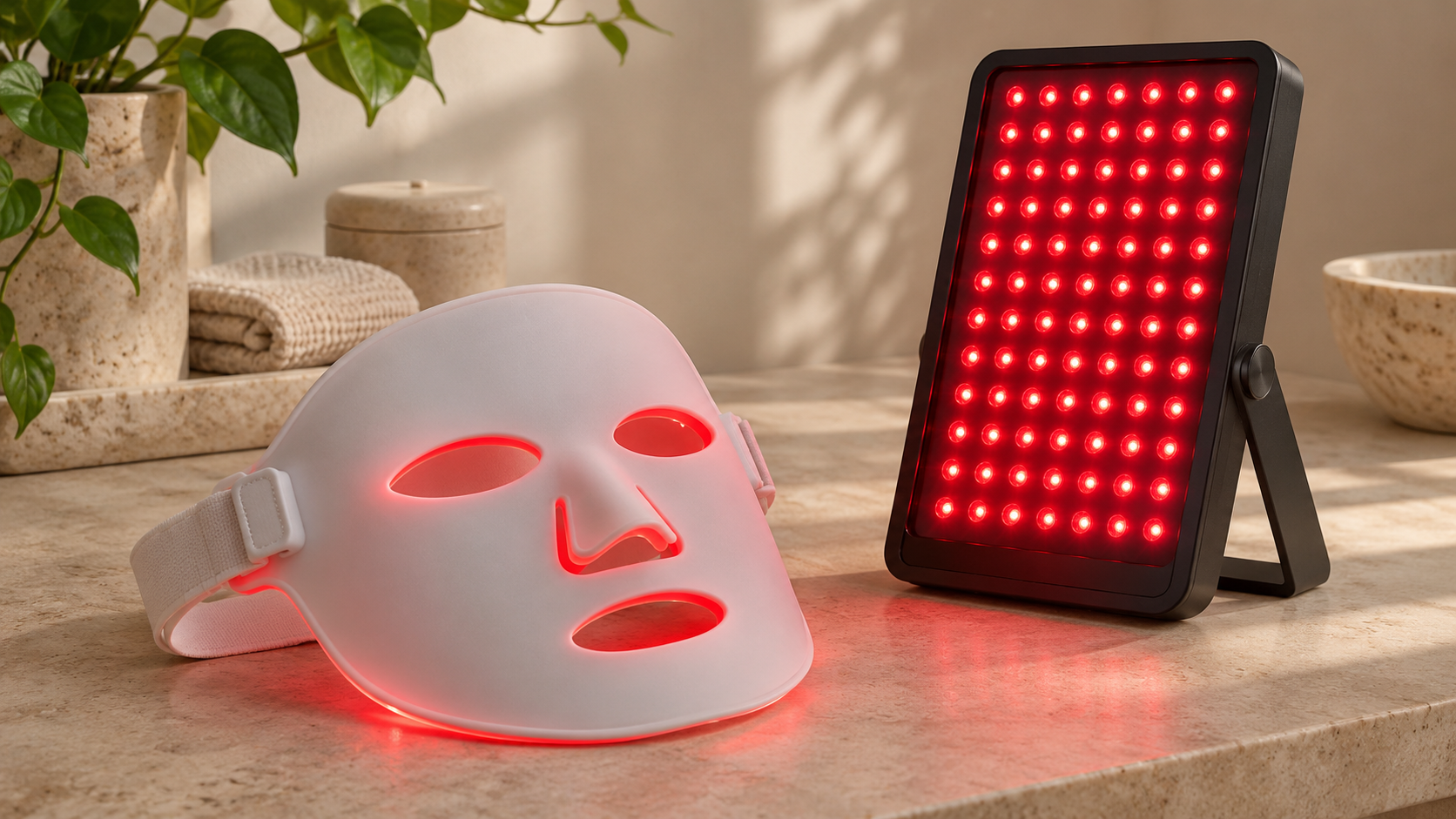
A face mask and a full-body panel can both glow red, yet they solve different problems. A mask may fit easily into a facial skincare routine. A panel may make more sense if you want to cover several areas. Before paying for more LEDs or a bigger panel, decide what you want to treat and check how much light the device delivers where you will actually use it.
In This Article
- Choose a format that fits your goal
- Read the specifications that matter
- Check safety, testing, and price
- Buyer’s checklist
Choose a format that fits your goal
| Format | Practical fit | What to check |
|---|---|---|
| Facial mask | Face-focused routine with little setup | Fit around nose and jaw, pressure points, eye protection, and intended use |
| Small panel | One localized area at a time | Mounting, working distance, and evenly lit area |
| Medium panel | A larger region or several smaller areas | Coverage at the stated distance and how often you must reposition |
| Full-body panel | Broad coverage where you have room for a stable setup | Front and back coverage, floor space, and uniformity across the advertised area |
Panel size labels are marketing shorthand. Compare the measured treatment area in inches at the distance you can maintain. For a face-only goal, a mask can be easier to use consistently. For the face and neck or several body regions, a panel may be more practical. A larger panel mainly buys coverage. It does not establish a better clinical outcome. For wrinkles, acne, and scalp-specific research, see our Red Light Therapy evidence guide.
Read the specifications that matter
- Wavelength: Look for the actual output in nanometers and which LEDs run in each mode. Visible red and near-infrared are separate bands. A familiar wavelength does not make two devices equivalent.
- Irradiance: This is power reaching a unit area, usually mW/cm². Ask for the measurement distance, instrument, and an average across the treatment area. A center reading measured against the panel can overstate what reaches most of your skin.
- Fluence: This is energy per area, usually J/cm². At a steady average irradiance, multiply mW/cm² by seconds and divide by 1,000. This estimates incident energy, not energy absorbed by skin or a recommended dose.
- Pulsing: Ask for frequency, duty cycle, and average output. Peak output during an on-pulse is not average output. Evidence for a particular pulsed protocol does not make every pulse mode superior.
- Flicker and comfort: Even a continuous mode can have output modulation from its electronics. Ask for measured flicker frequency and modulation depth by mode, and check brightness, glare, fit, and eye-protection instructions. A phone video or a “flicker-free” label cannot establish optical safety.
Check safety, testing, and price
“Medical grade” does not tell you what the device is cleared to do or which tests it passed. For a US FDA clearance claim, ask for the 510(k) number and confirm the model and indication in the FDA record. This FDA mask record illustrates how specific the intended use can be. A 510(k) clearance is a substantial-equivalence decision for that device and intended use. FDA registration or listing alone does not establish clearance, and clearance does not establish superiority. See the FDA’s explanation.
Ask for a report from a named independent lab identifying the exact model and mode. A spectral and irradiance report answers output questions. Photobiological, electrical, and battery safety reports answer different questions. Ask which standards and test conditions apply. If you have a photosensitive condition or take a medicine that can increase light sensitivity, ask a clinician or pharmacist about the device before using it.
Compare the total price after adding the stand, mounting hardware, shipping, and any replacement accessories. Pay attention to the warranty, return window, and support. A higher price can buy better coverage or a sturdier stand. It is not evidence of better results.
Buyer’s checklist
- Which area and intended use matter most to me?
- Can I maintain the specified distance and position comfortably?
- Can I see an independent report for the exact model, including output across the treatment area?
- Are the instructions, eye protection, and applicable safety records clear?
- What is included in the price, and what happens if the device fails or is uncomfortable?