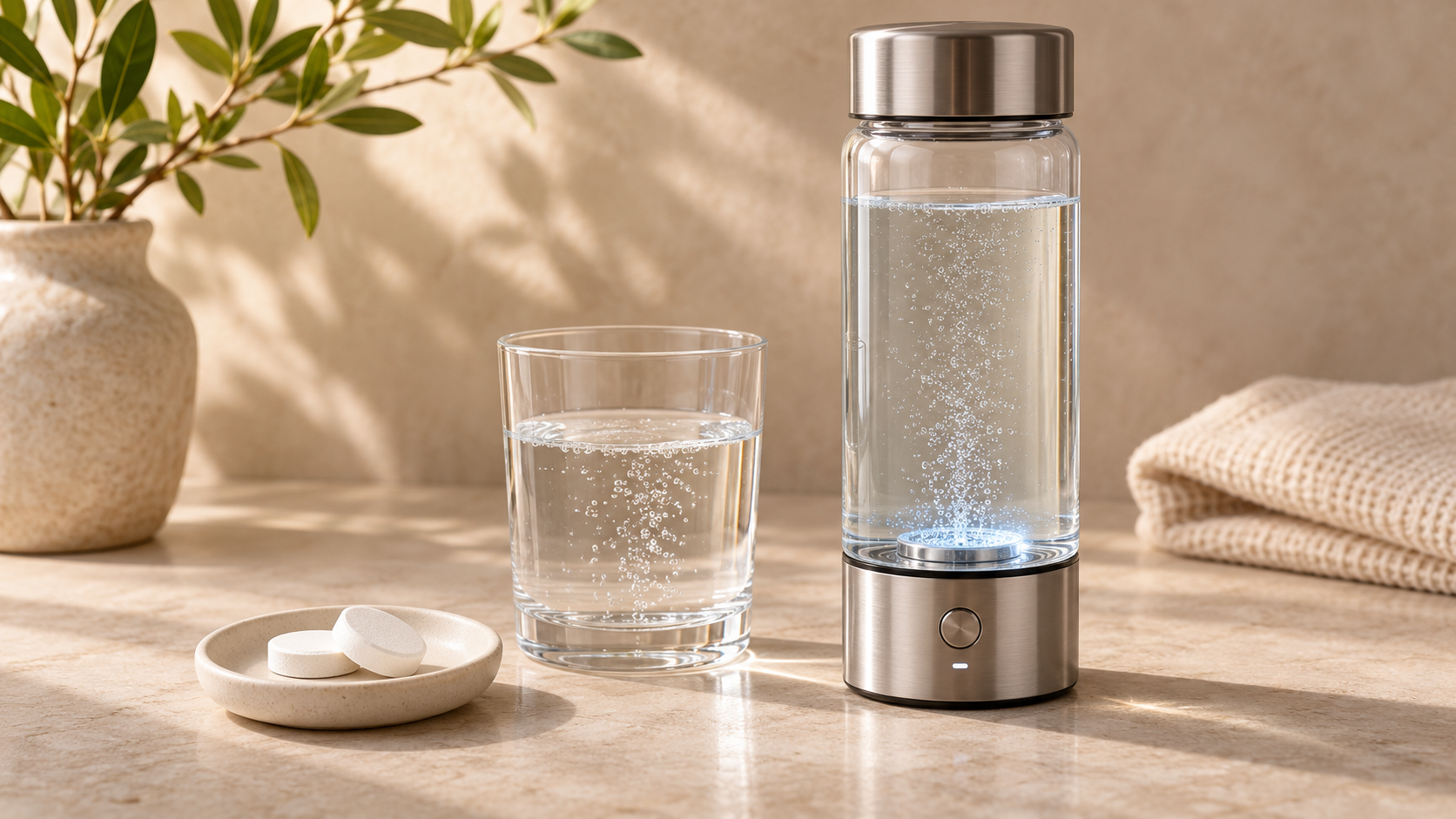
A tablet, a rechargeable bottle, and an inhalation machine can all be sold under the same molecular hydrogen label. Only the first two are ways to prepare water you drink. Before comparing prices, check how the product delivers hydrogen, what was measured, and whether the research studied that same route.
In This Article
- Compare the three delivery methods
- Read ppm, ppb, and mg/L correctly
- Evaluate the device and the test report
- Why inhalation belongs in a separate category
- Buyer’s checklist
Compare the three delivery methods
| Format | What it delivers | Main costs and upkeep |
|---|---|---|
| Hydrogen tablet | Dissolved hydrogen in water. Many tablets use a magnesium-based reaction. Check ingredients and preparation directions. | Recurring cost per tablet. Store as labeled and check expiration and serving size. |
| Generator bottle | Dissolved hydrogen produced by electrolysis during a cycle. Output depends on the model and test conditions. | Upfront cost plus charging, cleaning, and replacement seals or parts. |
| Inhalation | Hydrogen gas delivered through breathing equipment. Water concentration units do not describe gas exposure. | Specialized equipment and maintenance. Clinical evidence and gas safety require a separate assessment. |
A tablet study usually tests the water prepared with the tablet. It does not establish that another formulation or a generator bottle produces the same exposure. Similarly, a study using prepared hydrogen water tells you about the tested water and protocol, not the retail bottle you saw advertised.
Read ppm, ppb, and mg/L correctly
For dilute drinking water, 1 ppm by mass is approximately 1 mg/L, or 1,000 ppb. Concentration describes how much hydrogen is in a given volume. To estimate the amount swallowed, multiply the concentration at drinking time by the volume consumed in liters. For example, 0.5 L at 2 mg/L contains about 1 mg of dissolved hydrogen. That is an illustration, not a target dose.
Ask when the sample was taken. A reading immediately after generation in a closed bottle may differ from a reading after opening, pouring, or waiting. Ask for both an end-of-cycle reading and one under conditions that resemble your use. A pH or oxidation-reduction potential (ORP) reading alone cannot confirm dissolved hydrogen concentration. See our concentration, dose, and testing guide and the hydrogen measurement methods guidance.
Evaluate the device and the test report
An electrolytic bottle uses electricity to generate hydrogen at one electrode and oxygen at the other. PEM and SPE refer to a proton exchange membrane and a solid polymer electrolyte, respectively. The membrane helps separate the reactions. The label alone does not tell you how much dissolved hydrogen reaches your glass, how the device handles byproducts, or what enters the water from its materials.
Ask for an independent report specifying the model, water type, fill volume, temperature, cycle, time to sampling, and direct measurement method. Ask whether the finished water was checked for relevant byproducts and metals, especially if the instructions permit mineralized or chlorinated water. Check what the maker says about compatible water, descaling, cleaning frequency, battery life, and replacement parts.
For cost, compare the tablet price per prepared serving with the bottle price spread over realistic use, plus cleaning supplies and spare parts. A device you cannot clean or replace parts for can be expensive even if its purchase price is low.
Why inhalation belongs in a separate category
Inhalation exposes the lungs to a gas mixture. Gas concentration, flow, and exposure time cannot be converted into a drinking-water ppm recommendation. The HYBRID II randomized trial studied inhaled hydrogen during hospital care after cardiac arrest. The difference in its primary neurological outcome was not statistically significant. A small phase 1 study monitored short-term tolerability in eight healthy adults under hospital supervision. Neither establishes benefit or safety for unsupervised home use.
Hydrogen is flammable. The U.S. Department of Energy’s hydrogen safety guidance explains why ventilation and leak detection matter. Inhalation equipment requires controls for gas composition, leaks, ventilation, and ignition hazards. A gas-purity percentage does not show that those controls work or that the device is appropriate for personal use. Ask a qualified clinician about any proposed therapeutic use. For broader context, see our molecular hydrogen overview and exercise and recovery research review.
Buyer’s checklist
- Am I comparing prepared drinking water or a gas delivery device?
- What dissolved concentration was measured, how, and how long after preparation?
- What is the serving size, and what amount of hydrogen does that imply at drinking time?
- Is there an independent report for the exact model or tablet formulation?
- What are the ingredient, water compatibility, cleaning, warranty, and replacement requirements?
- Is the advertised benefit tied to a human study using this delivery method, or is it a testimonial?