What do an ancient Indian healing tradition, sugarcane, and a pharmaceutical scientist who dared to think differently have in common? They all played a part in the remarkable story behind Nano Soma.
Sometimes the most intriguing discoveries begin not in a sophisticated laboratory, but with something familiar that has been hiding in plain sight for generations.
For Dr. Raghavan, the scientist behind Nano Soma, that something was sugarcane.
As a child growing up in India, he remembers his grandfather taking him to roadside vendors where fresh sugarcane was crushed into juice.
His grandfather considered it one of the healthiest drinks available.
At the time, young Dr. Raghavan had no reason to imagine that those childhood experiences might eventually influence his life’s work.
Years later, after earning a PhD in organic chemistry and spending a decade working in pharmaceutical research, he began questioning something fundamental.
What if the answer to supporting better health wasn’t always about creating increasingly complicated substances, but about discovering new possibilities in compounds nature had already provided?
That question would send him on a journey connecting an ancient Indian temple, the science of plant waxes and an innovative formulation now known as Metadichol, the technology behind Nano Soma.
And the research that followed would take him into some fascinating areas of cellular biology, including nutrient regulation, metabolic health, cellular communication and the pathways associated with healthy aging.
In This Article
- How childhood memories and an ancient Indian tradition inspired Dr. Raghavan’s search
- Why his pharmaceutical research experience led him to explore a different approach
- How compounds associated with sugarcane eventually led to Metadichol
- The surprising research findings involving vitamin C and cellular communication
- Why Nano Soma is attracting interest in cellular wellness and healthy aging
From an Ancient Indian Temple to a Modern Scientific Discovery
A Childhood Connection That Would Come Full Circle
Dr. Raghavan grew up in Bangalore, India, surrounded by a blend of traditional knowledge, intellectual curiosity and an appreciation for the natural world.
His grandfather played an important role in his upbringing.
A well-read man with a deep knowledge of Sanskrit, English, history and philosophy, he encouraged conversations and questions about all kinds of subjects.
Traditional plant-based remedies were also a familiar part of everyday life.
But one childhood memory would become particularly meaningful decades later: visiting sugarcane vendors and enjoying freshly pressed juice.
His grandfather believed sugarcane offered something valuable for health.
It was a simple observation that stayed somewhere in the back of Dr. Raghavan’s mind, even as his interests turned toward chemistry and a scientific career.
From Pharmaceutical Research to a Different Question
Dr. Raghavan went on to study organic chemistry, eventually earning his PhD at Oregon State University.
He then entered the pharmaceutical industry, working in drug discovery and research, including at companies associated with Ciba-Geigy and Boehringer Ingelheim.
He understood how conventional pharmaceutical research worked because he had spent years doing it.
But in a 2025 interview with journalist Alison Jane Reid, Dr. Raghavan described becoming increasingly frustrated by the industry’s constraints on scientific creativity.
One experience in particular stayed with him.
At a scientific meeting in New York during the 1990s, he recalled hearing a physician-scientist speculate that a food-derived substance might one day offer an entirely different approach to medicine.
Others in the audience reportedly laughed.
Dr. Raghavan had a different reaction.
Instead of dismissing the idea, he began wondering whether there might be something worth investigating.
What if researchers started with familiar dietary compounds and explored their biological potential using the same sophisticated techniques employed in pharmaceutical research?
It was an idea that eventually redirected his career.
The Temple, the Jaggery and a Curious Tradition
The next piece of the story emerged when Dr. Raghavan learned about an ancient temple in southern India associated with healing.
In the interview, he describes the Vaitheeswaran Koil temple, traditionally associated with Lord Shiva in his role as a divine healer.
He recalls hearing about a custom involving jaggery, a traditional unrefined sugar product commonly made from sugarcane juice.
According to the tradition he described, visitors would bring jaggery and salt as part of a symbolic healing ritual.
The temple was surrounded by stories of remarkable healing properties.
For Dr. Raghavan, the interesting question was why sugarcane featured so prominently in that tradition.
Was there something in the plant beyond its familiar sweetness that deserved scientific attention?
That question brought him back to the sugarcane juice his grandfather had encouraged him to drink as a child.
Suddenly, an old memory and a new scientific question were pointing in the same direction.

The Overlooked Compounds in Sugarcane
Sugarcane is best known as a source of sugar.
But like many plants, it contains more than just the substances responsible for its sweetness.
Its outer waxy layer contains long-chain fatty alcohols belonging to a family of compounds called policosanols.
Related compounds occur in the waxy surfaces of other plants, including certain grains and fruits.
These waxes help protect plants from their environment.
Policosanols had already attracted scientific interest, particularly in research involving lipid metabolism.
But Dr. Raghavan became interested in another challenge.
These long-chain alcohols don’t dissolve readily in water.
He wondered whether changing how they were formulated might open up new possibilities for studying their interactions with biological systems.
A Breakthrough in Switzerland
After years of exploring his ideas, Dr. Raghavan collaborated with a colleague in Switzerland.
During the interview, he recalled that once they settled on the approach, they were able to develop an initial formulation within a matter of weeks in 2008.
The technology involved dispersing long-chain alcohols into extremely small droplets in a water-based nanoemulsion.
That formulation became known as Metadichol.
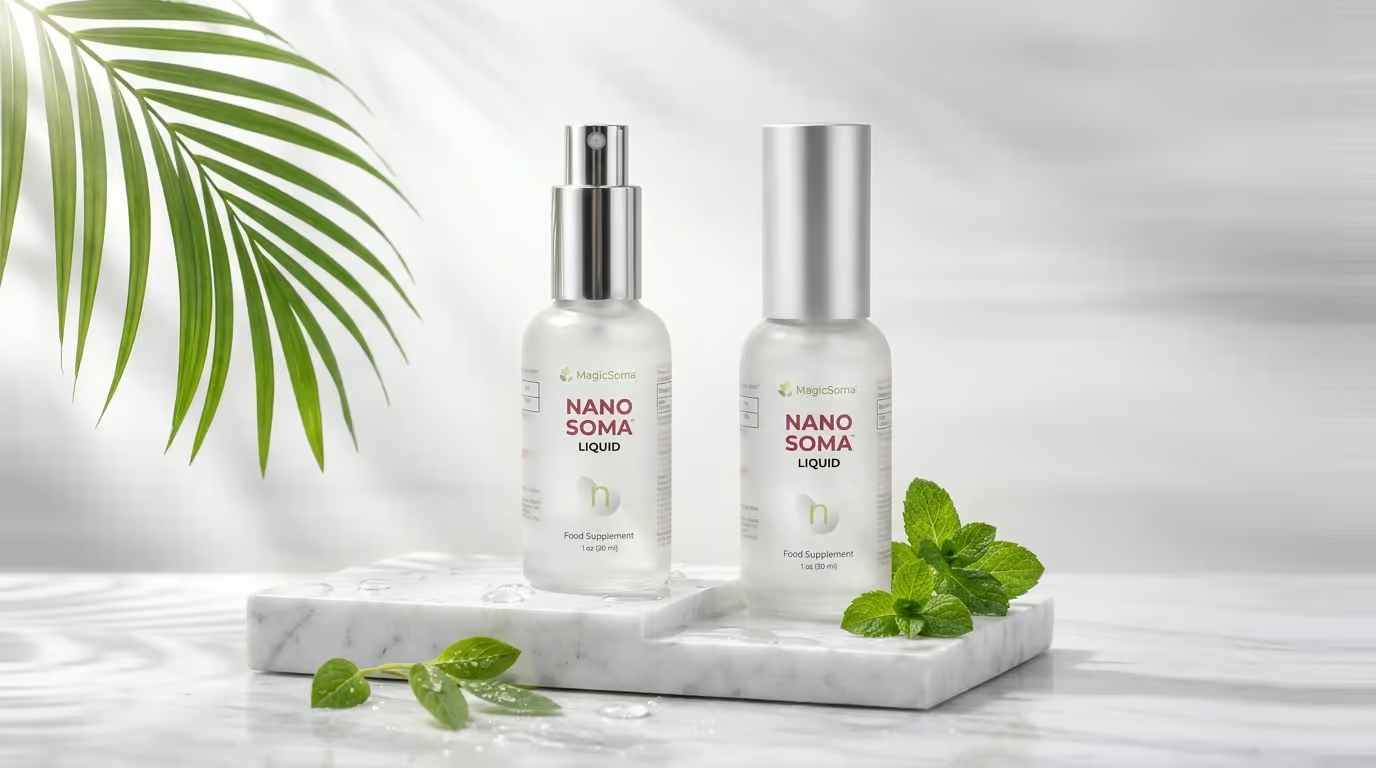
Nano Soma was developed around this technology.
The interesting part wasn’t simply making something smaller.
It was the possibility that a new formulation could change how these familiar compounds interacted with biological systems.
And that was where the next chapter began.
Because as researchers started investigating Metadichol, they reported effects involving vitamin C concentrations, cellular receptors, metabolic markers and several pathways associated with healthy aging.
What began with a childhood memory of sugarcane had developed into a research program exploring how cells communicate, respond and maintain themselves.
What If Wellness Isn’t Just About Adding More?
Walk through a supplement store and you’ll see products designed to supply almost every nutrient imaginable.
Vitamin C for antioxidant support. Magnesium for muscles and nerves. Various compounds promoted for energy, focus or healthy aging.
These nutrients have important roles, and correcting deficiencies can make a meaningful difference.
But nutrients don’t act alone.
Cells must constantly interpret information, respond to changing conditions and coordinate their activities with other cells.
Think of it as an extraordinarily sophisticated communication network.
Signals help regulate when certain genes become active, how cells respond to stress, and how the body coordinates everything from metabolism to normal immune function.
Researchers investigating Metadichol have reported interactions with some of these signaling systems.
That’s what makes the research distinctive.
Rather than focusing solely on how much of a particular nutrient is present, it raises questions about how the body regulates and uses the biological resources it already has.
The Vitamin C Finding That Raised Some Interesting Questions
Of all the Metadichol research, one of the most immediately intriguing findings involves something almost everyone recognizes: vitamin C.
Vitamin C supports collagen formation, normal immune function and antioxidant protection. Because humans cannot manufacture it through the usual biological pathway, we depend on our diets to obtain it.
In a small 2017 human study, researchers measured vitamin C concentrations before and during Metadichol use.
The results were unexpected.
That question is worth investigating.
After all, there’s a difference between consuming a nutrient and understanding all the processes that determine its availability to the body.
The study doesn’t establish which mechanism explains the increase, but it opens a potentially interesting avenue for nutritional research.
Cellular Communication: A Bigger Story Than One Vitamin
Another area of Metadichol research involves a group of cellular proteins called nuclear receptors.
You don’t need to know their individual names to appreciate why they’re important.
Think of them as part of the body’s internal control system.
They help cells respond to hormones and other signals, influencing processes related to energy metabolism, growth, development and normal immune regulation.
In 2023, researchers investigating Metadichol reported a striking observation involving the human nuclear receptor family.
Why is that interesting?
Because the body is not a collection of independent parts.
The systems involved in energy, metabolism, immune balance and cellular maintenance are interconnected.
Research that helps us understand those connections could eventually lead to new approaches to supporting healthy function.
And Metadichol’s interaction with these pathways is one reason the formulation deserves continued investigation.
What About Energy and Metabolic Wellness?
When people think about feeling healthier, they usually aren’t thinking about receptors or molecular pathways.
They’re thinking about having enough energy to enjoy the day, staying mentally sharp, maintaining a capable body and continuing to do the things they love.
Metabolic health plays an important role in those goals.
It involves how the body manages energy, blood glucose, fats and other essential processes.
A small 2017 human pilot study investigated Metadichol in 14 people with metabolic health concerns.
Researchers reported improvements in several measurements, including blood pressure and selected metabolic markers.
Nevertheless, the results provide another reason for researchers to look more closely at the formulation.
The interesting possibility is not that one spray replaces good nutrition, movement or other foundations of health.
It’s whether influencing certain cellular processes could eventually offer additional ways to support the body’s normal functioning.

And Then There’s Healthy Aging
Perhaps the most intriguing research direction involves some of the biological pathways associated with aging.
We all know that getting older is inevitable.
But how we function as we age can vary enormously.
Two people of the same age can have very different levels of energy, physical capability and resilience.
Scientists studying healthy aging are increasingly interested in what happens inside cells over time, particularly how they respond to stress, maintain normal functions and regulate energy.
Metadichol has been investigated in several of these areas.
Sirtuins: A Connection to Cellular Maintenance
Sirtuins are a family of seven enzymes involved in processes associated with metabolism, cellular stress responses and maintenance.
In a 2024 laboratory study, researchers reported that Metadichol influenced the expression of all seven sirtuin genes.
The investigation also examined other genes associated with cellular maintenance and aging-related biology.
These findings are particularly interesting because sirtuins are already an active area of investigation in the broader field of aging research.
They are involved in processes scientists believe may help explain why some cells maintain their functions better than others as they age.
BCAT1: Another Unexpected Connection
Researchers have also investigated Metadichol’s interaction with BCAT1, an enzyme involved in branched-chain amino acid metabolism.
Why does that matter?
Because related metabolic pathways have been studied in experimental organisms for their potential connection to lifespan and healthy aging.
A laboratory study reported that Metadichol inhibited BCAT1 activity, creating another possible direction for investigation.
It doesn’t establish that the product extends human life, but it illustrates how this research continues to uncover connections to cellular processes involved in aging.
What About Telomeres and Cellular Renewal?
Another intriguing area involves telomeres, the protective structures at the ends of our chromosomes.
Scientists have long investigated how telomeres, cellular maintenance and aging are related.
Some Metadichol laboratory research has explored genes involved in telomere biology and cellular renewal.
These findings are still at an early stage, but they contribute to the wider picture of why researchers are interested in the formulation’s potential effects on cellular processes.
The bigger question is whether these laboratory discoveries can eventually translate into meaningful differences in how people feel and function as they get older.
What Makes Nano Soma Worth Watching?
There are countless wellness products with impressive marketing messages.
What’s interesting about Nano Soma is the research program surrounding its underlying formulation.
The published work includes investigations involving nutrient concentrations, cellular signaling, metabolic measurements and biological pathways associated with healthy aging.
Some of the findings come from small human studies. Others come from laboratory experiments designed to explore mechanisms and generate new questions.
Much of the work has been led by Dr. Raghavan, the formulation’s developer, and independent confirmation will be important as the research progresses.
But early-stage science is often about discovering possibilities before their full significance is understood.
What makes this story worth following is the range of biological processes being investigated and the questions those findings raise.
Could a specialized formulation of naturally occurring compounds influence aspects of cellular communication?
Could that help researchers better understand how nutrients and metabolic signals are regulated?
And might some of these discoveries eventually contribute to new approaches to cellular wellness?
Those are worthwhile questions.
A Different Perspective on Feeling Better and Aging Well
At Fresh Unlimited, we’re interested in approaches that help people feel and function better, whether they’re familiar, emerging or a little unconventional.
Nano Soma fits that spirit of discovery.
Its development began with relatively simple plant-derived compounds and led to research involving some surprisingly complex biological systems.
The vitamin C findings are intriguing.
The nuclear receptor research suggests potentially broad interactions with cellular signaling.
And the investigations involving metabolism and longevity-associated pathways provide further reasons to follow future studies.
There’s still much to learn about what these observations mean in everyday human wellness.
But the underlying idea is compelling:
What if part of feeling and functioning better lies not just in what we give our cells, but in understanding how they communicate, respond and maintain themselves?
That’s a question worth exploring, at any age.
Research & Further Reading
- Metadichol formulation patent
- Metadichol and vitamin C: Human exploratory study, 2017
- Metadichol and the nuclear receptor family, 2023
- Metadichol and metabolic health pilot study, 2017
- Metadichol and sirtuin gene expression, 2024
- Metadichol and BCAT1 research, 2017
Source note: The biographical and origin-story details are drawn from Dr. Raghavan’s 2025 interview with journalist Alison Jane Reid. The interview describes his childhood memories, pharmaceutical research career, visit to the temple tradition through family accounts, and development of Metadichol.
This article explores published research for educational purposes and does not constitute medical advice.